Harmony by Julian Anderson

The Richard Jefferies Society has written to a young British composer congratulating him on his opening composition for the first night of the BBC Proms (12th July).

 The new work entitled Harmony, for choir and orchestra, by Julian Anderson lasted 5 minutes, was commissioned by the BBC and performed by the BBC Symphony Orchestra and Chorus. The piece was inspired by Richard Jefferies’ autobiography The Story of My Heart and words taken from it included:

 The clock may make time for itself; there is none for me...The shadow goes on upon the dial, the index moves round upon the clock, and what is the difference? None whatever. If the clock had never been set going, what would have been the difference?

Richard Jefferies Society Birthday Lecture 3rd November

Richard Jefferies was born on 6th November 1848. Each year the Richard Jefferies Society celebrate his birth with a Lecture as part of the Annual General Meeting.  This year Rebecca Welshman from the University of Exeter will speak on the subject of "Imagining Archaeology: nature and landscape in the work of Richard Jefferies."


The details are as follows:

Memorial event 16th March 2012 Eltham Churchyard

Richard Oliver Launcelot Jefferies (18th July 1883 – 16th March 1885) memorial – ceremony at St John’s Churchyard, Eltham on Friday 16 March 2012 at 2pm

Richard Jefferies Festival

Please go here to read more about the Richard Jefferies Festival taking place in Swindon from 24-28th August 2011.

You can download a copy of the full programme .

All events are free to attend. The Richard Jefferies Museum backs onto Coate Water (not as indicated on the flyer that points to the hospital).

Richard Jefferies: An Anthology by Hugoe Matthews and Rebecca Welshman.

This new anthology of extracts from Jefferies' writing is selected by Hugoe Matthews and Rebecca Welshman. It aims to highlight his broad, exploratory, and sometimes unpredictable nature in his works. The authors have focused primarily on short quotations which read well independently, and longer passages which demonstrate the context, the quality of the writing, or the flow of Richard Jefferies’ thoughts and observations. Where possible the selections are chronological and show a shift in the emphasis of his work from the 1870s, which focused largely on practical subjects such as farming and rural life, to his later work of increased sensitivity and perception of the natural world. Thereby they have sought to reveal the organic continuity and calm objectivity of Jefferies’ writing, which was present from his teens and addressed a diversity of subjects during an extraordinary era of change, illuminating both the man behind the words, and the times in which he lived. The Anthology is published in a case-bound, thread-sewn book of 266 pages.

The book was published on 6 November 2010 to celebrate 162 years since the day the author was born.

ISBN: 978-0-9563751-2-4. Price £20 (plus postage: £2.50 UK) It can be ordered via the Richard Jefferies Society.

Richard Jefferies’ science fiction book: basis for Birthday Lecture on 6 November


Professor John Carey (pictured above) will be giving this year’s Richard Jefferies’ Birthday Lecture on Saturday 6 November at Liddington Village Hall starting at 2.30pm, 162 years after Swindon’s most celebrated writer was born and raised at Coate Farm in 1848.

Adventures in the Vale of the White Horse


Exactly 100 years after Kate Tryon’s first visit to Swindon, to see the places that Richard Jefferies wrote about, her memoir of the occasion has been published by the Richard Jefferies Society.

60 YEAR OLD CINE FILM ABOUT RICHARD JEFFERIES FOUND IN A LOFT IN ESSEX RETURNS HOME

PRESS RELEASE: RICHARD JEFFERIES SOCIETY

2 March 2010

A cine film, made by the Film Production Unit of the Swindon Public Library Film Society in 1948, has found its way back to Swindon. The film, produced as a tribute to Richard Jefferies one hundred years after his birth, was found in a loft in Essex by Philip Mansbridge among films about trains.

RICHARD JEFFERIES “SPIRIT COUNTRY”

RICHARD JEFFERIES “SPIRIT COUNTRY”

An illustrated lecture by Roger Vlitos, photographer.

Liddington Village Hall, Saturday 11th October 2008: 2.30pm

MULBERRY TREE --COATE FARM

170 year old fruit tree snapped in two by winds

Richard Jefferies famous mulberry tree was another casualty of the high winds that blew across central England in the early hours of Monday (24 September) morning. The old tree, thought to be about 170 years old, was snapped in two and lost its main branch (see picture).

The tree forms the main focal point in the back garden of the Jefferies house and museum at Coate and was planted by Richard Jefferies father.Richard Jefferies sent many hours sitting under this tree and even composed a poem to it [1] when it lost a bough during his lifetime.Now others are penning their tributes to the tree and it is hoped that the wood from the fallen trunk can be seasoned and turned into something equally beautiful and memorable.

Jean Saunders, secretary of the Richard Jefferies Society said:"We are all heart broken to see the tree in its present state. However battered it may be, we will still love it and treasure it. The fruits are delicious and children have danced around it this year singing 'here we go round the mulberry bush'. To be on the safe side, we are taking cuttings but hope that the tree survives another century or two".

(1) Richard Jefferies wrote The Tree of Life about 1871, but it did not appear in print until three years after his death. It was published in the Scots' Observer on 8 November 1890 under the title of The Mulberry Tree. The poem, however, may have publicised in the columns of the Wiltshire and Gloucestershire Standard before this.

THE MULBERRY TREE

Oh, mulberry tree, oh mulberry tree
Dear are thy spreading boughs to me.
Beneath their cool and friendly shade
My earliest childhood laughed and played.
Or, lips all stained with rich red fruit
Slept in the long grass at thy root.

Oh mulberry tree, oh mulberry tree !
The yellow moonlight shone on thee.
A few low words - a gentle sigh,
A tear within the upturned eye.
“I love—my fate to thee resign"—
A nameless thrill, and she was mine.

The mid-day sun in splendour blazed,
And all who stood around me praised.
The deed was done, the fame went round,
My brows with laurel leaves were crowned
My first—my proudest victory
Beneath thy boughs, oh mulberry tree.

The tears of Heaven were falling fast,
Mourning the memory of the past.
I knelt beneath the broken limb
In rain and night, and wept for him.
I saw the tomb - the planks laid there,
To slide the coffin to its lair,
"Ashes to ashes", this the end,
My first, my last - my only friend!

The morning stars grew pale and few,
In chilly draughts the east wind blew,
Lifting the black and frost-strewn leaves
In rustling eddies to the eaves.
Deceived no more with life's vain lies,
And all things equal in mine eyes,
I wait still near the mulberry tree
The dawning of eternity.

Whoe'er shall pluck the mulberry tree,
Bitter and sweet its fruit shall be;
Such - joy and misery still at strife -
The berries of the Tree of Life.
PRESS RELEASE

Antique bust of Richard Jefferies presented to the Jefferies Museum by Salisbury’s Mayor

On 2nd April, Sheila Warrander, the Mayor of Salisbury District Councillor and Cllr. Justin Tomlinson, Swindon Borough Council’s cabinet member for leisure, culture and recreation unveiled an antique bust of Richard Jefferies [1] at the Jefferies Museum at Coate[2] that has graced the committee room in Salisbury for over 80 years.

The white alabaster bust is a replica of the marble statue sculpted by Margaret Thomas that was unveiled in Salisbury Cathedral in 1892. It is believed that Miss Thomas made about five plaster replicas and it appears that this copy was once owned by Jefferies' Biographer Walter Besant, from whom it passed to the Association of Authors in London. The bust was offered for sale to Salisbury City Council, who declined it at first but then Alderman Frederick Sutton the renowned local confectioner and later Mayor of Salisbury bought the bust and presented it to the council in 1925. This particular copy of the cathedral bust appears to be the only one remaining apart from a version made for London’s National Portrait Gallery.

John Price, Chairman of the Richard Jefferies Society said:

“We are most grateful to Salisbury District Council for this rare and most welcome honour. The sculptress, Margaret Thomas, had but a few pictures of the writer on which to base her work. Jefferies had recently died, in 1887, aged only 37. Miss Thomas spoke to family and friends of the writer and mainly used a photo taken when Jefferies was 30 years old. We have given the statue pride of place on display in the large bay window of Jefferies’ sitting room”.

Mrs Sheila Warrander, the Mayor of Salisbury said:

“We have recently started to refurbish and extend our offices in Salisbury and, in knowledge that the Jefferies Museum is expanding its collection, it seemed appropriate to lend the statue to the museum where it can be appreciated by more visitors. We are delighted to find this perfect home for the sculpture. It is a charming museum”.

The Mayor was accompanied by Steve Milton, Salisbury District Council’s Principal Democratic Services Manager whose great grandfather was a friend of the author [3], along with Ruth Davies from the same department. Councillor Justin Tomlinson was accompanied by Paul Blacker, Director of leisure, culture and recreation for Swindon Borough Council. John Price, John Webb and Jean Saunders attended on behalf of the Richard Jefferies Society.
The Jefferies Museum is next open on Wednesday 11th April from 10am to 4pm. Admission is free and there is a creative writers’ group workshop running at the same time that visitors can join.


ENDS

Editors notes:

[1] Richard Jefferies was born at Coate Farm near Swindon on 6th of November 1848. The author spent his childhood exploring Coate Water and the local fields and woods, observing wildlife and nature. The area around his home at Coate has been known for years as “Jefferies Land”. It has become a place of pilgrimage for generations of readers.
Jefferies had a great exhilaration for life although he died from tuberculosis at the age of 37 and spent his last ten years in extreme pain. None the less he wrote over 20 novels and hundreds of essays many of them based on his life at Coate and his observations of nature and rural life. He has been described as a “many sided genius”. Historians cite him as an authority on agriculture in Victorian England. Major studies of mysticism have anthologised his work and discussed his ideas. He wrote one of the great novels for boys, Bevis, the Story of a Boy as well as several highly original novels for adult readers. He is recognised as one of the greatest nature writers in the language and he topped a Guardian 2005 poll for Britain’s favourite country writers.

[2] The Richard Jefferies Museum is situated between the Sun Inn at Coate and Day House Lane opposite the petrol station on the Marlborough Road. The old farm was purchased by Swindon Corporation in 1926 and it is still owned by Swindon Borough Council. The museum was opened to the public on a limited basis in the 1960’s. The Richard Jefferies Society, founded in 1950, has supplied the majority of the exhibits in the museum and for the last twenty years has provided volunteers to open the museum on the first and third Sundays of the month from May to September between 2-5pm and the second Wednesday of the month throughout the year from 10am to 4pm. Admittance to the house and grounds is free.

[3] Steve Milton is the great grandson of John William North ARA RWS the well known Victorian painter and friend of Richard Jefferies. Jefferies stayed with North in Somerset during his research for Red Deer and Wild Life in a Southern County. North had visited Jefferies on several occasions and was present on the day he died. North took in Jefferies' widow Jessie and his children to live with him in Somerset, he raised a fund to assist the family that raised around £1,300 in donations and he helped secure a pension from Parliament to assist them. North was on the committee that erected the bust in Salisbury Cathedral.

New life for the Richard Jefferies Museum at Coate

PRESS RELEASE New life for the Richard Jefferies Museum at Coate This year there will be a burst of new activities at the Richard Jefferies Museum (1) thanks to a grant from the Lottery’s Awards for All programme (2). The Richard Jefferies Society (3) has been awarded £9,200 for a community project entitled “Footsteps of Richard Jefferies” that aims to encourage local people to become better acquainted with their local writer (4) born at Coate Farm in 1848, to visit places that influenced his work and be inspired to write themselves. There will be story telling walks and adventures based on extracts from Jefferies’ children’s fable Wood Magic (published in 1881) that will be led by Hilda Sheehan, a Kindermusik Educator. Writers workshops for adults and schools will be run by community poet, Tony Hillier. A guided walk around Coate Water and the museum will be led by Mark Daniel and a tour guide will be produced. Jean Saunders, secretary of the Richard Jefferies Society said: “This grant couldn’t have come at a better time. Last year there was a record number of visitors to the Jefferies’ museum and volunteers have been working really hard to make the place more inviting. The old dairy farm is full of atmosphere yet many Swindonians know nothing about the home of one of England’s finest nature writers or the man. With this grant we hope to put that right and make the town proud of its unique literary heritage”. Robert Buckland, Parliamentary Candidate for Swindon South said: "The legacy of Richard Jefferies will be well and truly brought to life by this important project. My congratulations and good wishes to a Society that deserves our fullest support." The grant will be used to fund the following events that are free for participants:  Writers’ workshops for adults have been set up and are held on the second Wednesday of the month from 10am to 4pm at the museum. From today schools can book two hour sessions throughout the school terms by contacting Tony Hillier on 01793 346440. A pamphlet of works will be produced at the end of the year.  The story-telling walks are geared, in particular, for young children. The stories include ‘The Cunning Spider’ who lived in the Coate Farm garden and such was his skill at capturing flies that the toad, who lived under the rhubarb bush, hatched a plan to outwit the spider. As well as the story walk around the museum and grounds that will be launched in May there will be activities such as treasure hunts and children will be given an illustrated book of stories. Other story walks will be organised at 11am on certain Sundays of the month until the end of September.  The Guided walk around Coate Water and Coate Farm will take place on Sunday 3rd June but the leaflet describing the tour will be available at Coate Water and the museum next month. For more information about the events contact Jean Saunders on 01793 783040 or e-mail R.Jefferies_Society@tiscali.co.uk. ENDS Editor’s notes (1) The museum, next to Coate Water, was once a small dairy farm and the birthplace and home of Richard Jefferies, an influential Victorian nature writer. The farm was bought by Swindon Corporation in 1926 and as a result of loans from members of the Richard Jefferies Society, an exhibition has been established there. (2) Awards for All is the small grants scheme administered by the Big Lottery Fund on behalf of Lottery good cause funders, Arts Council England, Big Lottery Fund, Heritage Lottery Fund and Sport England. The scheme makes awards of between £300 and £10,000 to grass roots community groups and voluntary organisations. (3) The Richard Jefferies Society was founded in 1950 to promote the appreciation and study of the writings of Richard Jefferies. There are about 300 members spread around the world. The Society provides volunteers who open the Jefferies’ museum to the public on the first and third Sundays of May to September inclusive from 2-5pm and on the second Wednesday of the month from 10am to 4pm throughout the year. (4) Richard Jefferies was born at Coate Farm on 6th of November 1848 and it was his home until his late twenties. The author spent his childhood exploring Coate Water and the local fields and woods, observing wildlife and nature with an enquiring eye. The area around his home at Coate has been known for years as “Jefferies Land”. It has become a place of pilgrimage for generations of readers. He has been described as a “many sided genius”. Historians cite him as an authority on agriculture and rural life in Victorian England. Major studies of mysticism have anthologised his work and discussed his ideas. He wrote one of the great novels for boys (Bevis based around adventures at Coate and Coate Water), as well as several highly original novels for adult readers. He is recognised as one of the greatest nature writers in the language and he topped a Guardian 2005 poll for favourite country writers. He married Jessie Baden from neighbouring Day House Farm and his final home was at Goring by Sea near Worthing where he died of tuberculosis at the age of 37.

Coate Farm out-buildings better protected by law

Coate Farm out-buildings better protected by law 

 Today, the Richard Jefferies Society is celebrating the news that Elaine Pearce, the Secretary of State for Culture, Media and Sport has authorised a new listing description for the Richard Jefferies Museum at Coate that would better serve to protect the out-buildings and built features in the grounds of the old farm. The Society wrote to English Heritage in late 2005 when they discovered that the description of the Grade II listed building on the Marlborough Road, that was first designated as such in October 1951,only mentioned the old thatched cottage and museum and not the other farm buildings and man-made structures that were so important to the Victorian author’s writing [1]. Specifically the group requested that the old barn, dairy, the pig-sties, the ha-ha wall [2] and the main garden wall along with a field boundary marker stone were included in the description. The Society were delighted to learn that their request had been fully investigated and their wishes granted [3]. A spokesperson for the Richard Jefferies Society said: “Over thirty years ago we were fund-raising to restore the farm-buildings that the owners, Swindon council, planned to demolish although by this time, the thatched cow-sheds and hay-rick barn had already gone. At that time we were helped by celebrities such as John Betjeman and Spike Milligan who were enthusiastic Jefferies’ fans. "Visitors to the Museum are so thrilled when they can look at features and buildings that they have read about. For example, there is a square drain in the ha-ha wall where Jefferies describes watching wildlife shelter. We are delighted with the news that what remains might now be better protected.” The Jefferies Museum will be open on Wednesday 13th December from 10am to 4pm. The Richard Jefferies Society is holding a meeting at the Jefferies Museum on Saturday 2nd December at 2pm when there will be an opportunity for people to delve into some of the archive files that the Society has built up over the last 50 years or more Both events are free and open to the public. More information from Jean Saunders, Secretary of the Society, on 01793 783040. ENDS Editor’s notes: [1] Richard Jefferies was born at Coate Farm near Swindon on 6th of November 1848. The author spent his childhood exploring Coate Water and the local fields and woods, observing wildlife and nature with an enquiring eye. The area around his home at Coate has been known for years as “Jefferies Land”. It has become a place of pilgrimage for generations of readers. Jefferies had a great exhilaration for life. His unique expression of his relationship to nature has won him a secure place in the hearts of imaginative people. He has been described as a “many sided genius”. Historians cite him as an authority on agriculture and rural life in Victorian England. Major studies of mysticism have anthologised his work and discussed his ideas. He wrote one of the great novels for boys, as well as several highly original novels for adult readers. He is recognised as one of the greatest nature writers in the language and he topped a Guardian 2005 poll for favourite country writers. [2]pictures removed [3] Copy of the English Heritage listing dated 10 November 2006 SU 18 SE 4/57 2.10.51 SWINDON MARLBOROUGH ROAD Coate Richard Jefferies Museum II A C17 farmhouse with an adjoining early C19 house, now used as a museum. EXTERIOR: The C17 house is built of limestone rubble with a thatched roof and brick gable stack. The low, one storey building, with attic above, has a two-bay east front with a central entrance porch (added later) and an early C19, slate cat slide extension to the south and west ends. The early C19 farmhouse is attached to its west. It is a three storey building constructed of Flemish bond brickwork with a slate roof, with brick chimney stacks at both gable ends. The north front has three bays with an entrance left of centre comprising a six-panelled door with splayed stone lintel, flanked to the left by a hipped bay window with twenty-pane sashes and to the right by a three-light leaded timber window with a splayed stone lintel. Above the entrance on first floor level is a two-light leaded timber window flanked on either side by three-light leaded windows, all with splayed stone lintels. Above the latter at attic level are two smaller three-light leaded timber windows. The rear of the house to the south has scattered fenestration, and the west gable end has two-light timber windows to the right on first floor and attic level. INTERIOR: The C17 farmhouse has been significantly altered and restored in the C19 and C20. The early C19 house has panelled window reveals on ground and first floor levels. There is a contemporary inlaid slate fireplace on ground floor level and In the first floor bed room a timber fire surround with grate and a built-in six-panelled wardrobe. SUBSIDIARY FEATURES: The garden, orchard and farmyard at the Richard Jefferies Museum, enclosed by a stone wall along Marlborough Road (moved and rebuilt in the mid C20), contain a series of outbuildings and structures dating from the C19 some incorporating earlier fabric possibly dating from the C17 or C18, including a dairy (re-roofed in the mid C20), a barn with a stable (and hayloft above), a pigsty, a workshop, a garden bothy, a ha ha and a boundary stone (the latter was moved from elsewhere on the former estate). HISTORY: The farmstead, originating from the C17 and formerly known as Coate Farm, is the birthplace of the nature writer Richard Jefferies (1848-1887)and which is thought to have formed the main inspiration for his books. In the mid C20 it became the Richard Jefferies Museum. SUMMARY OF IMPORTANCE: The Richard Jefferies Museum is a C17 farmhouse with an adjoining early C19 house and associated outbuildings and structures, forming an interesting historic farmstead. The various buildings show how this farmstead evolved over time, and it is also an interesting surviving example of a group of vernacular buildings on the outskirts of Swindon. Additionally, the farmstead is the birthplace of the nature writer Richard Jefferies (1848-1887), and together with its surrounding landscape, in particular the Coate Water Reservoir, it formed the main inspiration for Jefferies books, including Bevis and Amaryllis at the Fair. SOURCES: M Daniel, 'Return to Jefferies' Country' in Country Life, 12 December 1974; B Cherry and N Pevsner, The Buildings of England (1985 2nd edn), p 516; J Chandler, Coate and Richard Jefferies (2005); 1st edition Ordnance Survey, surveyed 1878, published 1882; P.G. Herring Jefferies Farm, Coate, Wilts, a plan of the farmstead by Beauchamp (1923). Dated:- 10th November 2006 Signed by authority of the Secretary of State ELAINE PEARCE Department for Culture, Media and Sport

Jefferies' tree at Coate Water immortalised by plaque

Jefferies' tree at Coate Water immortalised by plaque 

 PRESS RELEASE 


 A new wooden plaque will be unveiled at Coate Water at 12 noon on Sunday 10th September, as part of the Heritage Day celebrations, to commemorate an oak tree that was immortalised by Richard Jefferies in his boys' adventure story, Bevis [1] first published in 1882. The 'Council Oak', as Jefferies described it, is an ancient tree growing alongside the eastern shore of Coate Water lake near the children's sand-pit. It is a place of pilgrimage for devotees of Jefferies' writing. Richard Jefferies, born in 1848, was raised at Jefferies Farm - now a Museum - some 500 metres from the tree. Bevis reflects Jefferies' own childhood adventures around Coate. In the book, the tree was the meeting place for local boys to plan their council of war that led to their mock battle in the nearby field, on Day House farm, named the 'Battlefield of Pharsalia'. The tree was chosen because "it was known by everyone. It grew all alone in the meadow, and far from any path, so that they could talk as they liked". Coate Water was called the 'New Sea' by Bevis. The tree's position was marked on maps published in various editions of the book. Around 1990, this magnificent oak tree suffered from a natural and rare condition known as 'limb drop' whereby it lost its crown. Another victim of age was the wooden plaque erected next to the tree made by Cyril Wright, a long-standing secretary of the Richard Jefferies Society. The new plaque was made by students at Dorcan Technical College under the supervision of teacher, Ivan Kirk. The school has added a dedication to teacher, John Venables, who was instrumental in getting the plaque accepted as a project. His sudden death this year came as a shock to all. Ray Morse, Vice-chairman of the Richard Jefferies Society, said: "John Venables was energetic and full of enthusiasm to help when I asked if his students might make a new plaque for the tree. The 'Council Oak' is part of our literary heritage. The new memorial plate not only acts as a marker but celebrates the passing of a great local writer as well as friends old and new". John Price, the Chairman of the Richard Jefferies Society, will welcome friends of Richard Jefferies and Coate Water to the unveiling ceremony at 12 noon on Sunday and read a relevant extract from Bevis. The Jefferies Museum will be open later from 2-5pm. 

 - ENDS - 

***** Editor's notes: [1] BEVIS: CHAPTER XIV - THE COUNCIL OF WAR opens: "I say!" ''Battleaxes - '' "St. George is right 'Hold your tongue." 'Pikes twenty feet long." 'Marching two and two." 'Do stop." 'I shall be general." 'That you won't." 'Romans had shields." 'Battleaxes are best." 'Knobs with spikes." 'I say - I say!" 'You're a donkey!" 'They had flags - " 'And drums." 'I've got a flute." 'You!" 'Yes, me." 'Hi!" "Tom." "If you hit me, I'll hit you." "Now." "Don't." "Be quiet." "Go on." "Let's begin." "I will" - buzz - buzz - buzz ! Phil, Tom, Ted, Jim, Frank, Walter, Bill, "Charl," Val, Bob, Cecil, Sam,Fred, George, Harry, Michael, Jack, Andrew, Luke, and half a dozen more were talking all together, shouting across each other, occasionally fighting, wrestling, and rolling over on the sward under an oak. There were two up in the tree, bellowing their views from above, and little Charlie ("Charl") was astride of a bough which he had got hold of, swinging up and down, and yelling like the rest. Some stood by the edge of the water, for the oak was within a few yards of the New Sea, and alternately made ducks and drakes, and turned to contradict their friends. On higher ground beyond, a herd of cows grazed in perfect peace, while the swallows threaded a maze in and out between them, but just above the grass. The New Sea was calm and smooth as glass, the sun shone in a cloudless sky, so that the shadow of the oak was pleasant; but the swallows had come down from the upper air, and Bevis, as he stood a little apart listening in an abstracted manner to the uproar, watched them swiftly gliding in and out. He had convened a council of all those who wanted to join the war in the fields, because it seemed best to keep the matter secret, which could not be done if they came to the house, else perhaps the battle would be interfered with. This oak was chosen as it was known to everyone. It grew all alone in the meadow, and far from any path, so that they could talk as they liked."

September Nature Notes

September Nature Notes 

Extracts from Wild Life in a Southern County related to the orchards at Wick House [Jefferies' Farm]. 


"Be careful how you pick up a ripe apple, all glowing orange, from the grass in the orchard ; roll it over with your foot first, or you may chance to find that you have got a handful of wasps. They eat away the interior of the fruit, leaving little but the rind, and this very hollowness causes the rind to assume richer tints and a more tempting appearance. Speckled apples on the tree, whether pecked by a blackbird, eaten by wasps or ants, always ripen fastest, and if you do not mind cutting out that portion, are the best. Such a fallen apple, when hollowed out within, is a veritable torpedo if incautiously handled. Wasps are incurable drunkards. If they find something sweet and tempting they stick to it, and swill till they fall senseless to the ground. They are then most dangerous, because unseen and unheard ; and one may put one's hand on them in ignorance of their whereabouts. 

----- Dusky Blenheim oranges, with a gleam of gold under the rind ; a warmer tint of yellow on the pippins. Here streaks of red, here a tawny hue. Yonder a load of great russets; nearby heavy pears bending the strong branches; round black damsons; luscious egg-plums hanging their yellow ovals overhead; bullace, not yet ripe, but presently sweetly piquant. On the walnut trees bunches of round green balls-note those that show a dark spot or streak, and gently tap them with the tip of the tall slender pole placed there for the purpose. Down they come glancing from bough to bough, and, striking the hard turf, the thick green rind splits asunder, and the walnut itself rebounds upwards. Those who buy walnuts have no idea of the fine taste of the fruit thus gathered direct from the tree, when the kernel, though so curiously convoluted, slips its pale yellow skin easily and is so wondrously white. Surely it is an error to banish the orchard and the fruit-garden from the pleasure-grounds of modern houses, strictly relegating them to the rear, as if something to be ashamed of."

AUGUST NATURE NOTES

AUGUST NATURE NOTES are taken from 'A Summer Evening'. First published in 1881 in the Pall Mall Gazette, later in Chronicles of the Hedges The sunlight falling on the tree trunks pales as it comes from the westward, having lost the glare of the south. At noon the trunks were in shadow with the sun straight over, and the appearance of the beams upon the stems as he declines marks the coming of the evening. The shrill note Pied wagtail echoes from the building, and it is noticed because the other birds are silent while the sun is going down. Long hours of heat seem to have burned the blue out of the sky; it pales as the light goes, and the faintest white haze mingles with it as if an invisible gossamer mist were spread over. In the deep shadow of the elms—a double shade from a double row—the horses are a little happier at last; but for hours yet their heads will nod, nod ceaselessly up and down, shaking off the torment of flies. At horse-hoe in the morning there seemed to be a green bush moving across the field between the rows of roots, for a bough was thrust into every crevice of the harness, and others were hung over or tied on, so that the horse was caparisoned with drooping branches. They withered and became a listless green in the sun before an acre was finished, but, swinging at every step, drove away the insects. With the first sunbeam the insects began, and will continue long after the last ray has departed. No files of rooks stream across the country as they would do in winter—they are late to return to their trees, and do so in scattered parties. The wood-pigeons, too, have not finished yet, and the sparrows are still in the corn; you can see where they have cleared out every ear in a corner by the white and chaffy appearance, while elsewhere the wheat is golden. The house-martins are still busy bringing mortar from the shore of the pond, where they drag their white legs over the moist earth, floundering and flutter­ing as they lose their balance. The swifts are screeching round the houses, or the church, so that the sky seems vacant, till, perhaps, a heron comes over, high up and slow as a cloud. If you put your hand on the top bar of a gate it is still warm, the mirage has disappeared, and does not quiver; but in walking through the fields now and then, a heated section of air is entered, much warmer than the rest of the atmosphere. Where the earth lies fallow the dry clods take a browner tint. A sudden movement in the wheat close by shows where a hare has already left his form well concealed by the tall stalks, but a pheasant in the barley may crouch and lie still. You may step right in among a covey of partridge chicks, if you come quickly and noiselessly over the gate without a dog. They are in the long grass between the wheat and the hedge, where there are ant hills; their first instinct is to 'quat' and before they can run you are in the middle of them. The strongest perhaps fly and drop twenty yards out in the wheat, the others ' cheep ' and run in among the stalks, tumbling in their eagerness over the clods. If you wished you might put a broad-brimmed hat over and cap­ture one as children do butterflies. They are the prettiest little things, and he must be hard-hearted who would not handle a partridge chick tenderly. Any little stream greatly puzzles them if they cannot fly. A burdock leaf would hide the whole covey. By now every tall bunch of grass casts a shadow, and a softer hue steals forth over the dry corn. What is the name of the colour of the barley? For in and among the rest there is a flicker of red fire which cannot be fixed, disappearing if looked for steadily. But as you first glance at it there seems sparks of redness here and there, as if the colour at those places came to a point. In reality there is no such redness, nor could you find it in a whole field ; the barley is broadly yellow, faintly green, dashed a little with orange, the most difficult of hues to give an idea of, and only seen in perfection when long weeks of fierce sunshine (as this season) have left an essence of the sunlight on it. The oats before they whiten have a delicate green of their own, less pronounced than eau de Nil, pearly yet not pearl grey. Out from the hedges the shadow comes, and far in front of the shadow a penumbra of lesser light; soft still hues settle on the surface. The disc of the sun goes down yellow, and not so bright but that it can be looked at; the sky at the horizon is a faint yellow — a pale glow that seems weary and worn out with heat. Some might say so pale a sunset meant rain. But look to the east. There the atmosphere thickens to a dull red, like a heated tile; and so long as that dull red glow comes evening after evening the wheat will stand in earth as hard as a kiln could make it. If the hills seem near and clearly defined it is because the air has been burned with sunlight, and because the slopes are distinct with squares of yellow corn. Overhead the faint whitish mist disappears and leaves a purple sky; beneath, over the broad fields, the shadows have gone. Instead of bright light and dark contrast, there is a light everywhere, soft and quiet, as if it came through the dome of purple. Grasshoppers still sing on the short turf where the worn ground shows white and dry through the thin blades. The ants have not yet finished, nor the bees; as they go home the moths come forth. On a bare bough a shrike is still intent on every passing insect, and calls ceaselessly to her young perched in the bushes. From the fern a nightjar rises and starts upon his uncertain course like a larger swallow of the night. There are thrushes in the aftermath, and the brownish spots farther away which move now and then are rabbits. Flocks of rooks are stationary on the ground by the corn, but outside it; at the brook the water-rats feed, and the moorhens, birds both of day and night; and the yellow-hammer sings till the first beetle hums over the hedge. The yellow glow in the west sinks away, leaving only a whiter light there to distinguish the place of sun-setting. Distant corners of fields grow dusky, and in the copse under the trees there are passages which look dark a short way off, though not so when actually beneath the boughs. The little green that is yet left in any of the later corn or found along the edges among the weeds and wild flowers comes up, as it were, to the surface. So, too, with the white tints, the whiteness of the oats, of the driest and ripest of the wheat-stalks, of the white flowers and dusty sward, of the earth itself whitened by heat. White and green tone everything, and the gold is deadened, but the purple overhead is still clearer and seems higher. The hares are happy now, and may be seen wherever the second crop of clover is not too tall to hide them, or met with stealing along the quiet lanes where the nuts are already enlarging upon the hazel. A bat appears and flies to and fro at a great height; the bats do not seem to hawk so much in the summer as in spring, or perhaps not till late—at least, they are not so conspicuous. The swallows are still on the wing, and even yet it is some time before the first star. Not much effort is made by the birds to find a roosting-place. The barn and the bushes by it, an old fir tree grown about with ivy, from which long straws depending betray a nest—these suffice the sparrows. Almost the first bough answers, as they are all clothed with foliage. Those birds that have a second brood choose a branch adjacent to the nest: if not, wherever the deepening dusk finds them, there is sure to be a bush or tree. Now and again, as the beetles hum more often, a faint air comes over the corn—cool, but not chilly—scarce enough breeze to rustle the wheat-ears. Stand still while it lasts; it is too delicious to miss the least portion of, and it will only blow a minute. A star parts the purple veil at last. The purple is less now and the blue more; and after the first the stars come forth, each with a shorter interval between. There is no haze, and southwards where the horizon is darkest the stars shine low down as it were to the surface of the wheat. A white owl passes under the trees, and the chirruping of the crickets on the mounds sounds in the still­ness across the fields. A rook, or perhaps a night-wandering crow, flits by, just clearing the hedge towards the copse. The nightjar floats again, rising to the top of the oak yonder. All the breadth of the white corn is visible, the hedge on the other side, the elms farther still, a rolling slope of corn beyond that, and the distant hills. But yet, though it seems so light and clear, if the eye endeavours to single out an object it fails to define it. Whether there may or may not be someone behind the elm yonder, whether someone may or may not be stealthily moving along the hedge, is not certain, and the longer the gaze is fixed the more shadowy the object looks. It is a shadow: it is not a shadow: a horse perhaps? No, nothing; merely a spot where a projecting bush deepens the dusk. All things are visible, and yet invisible; they have no outline, no definition. The stars thicken, and with them comes a sense of intense rest. The light is not gone, but only enough left to incline the thoughts to quiet; there is no darkness, but that shadow which soothes and inclines to dream. The heated earth cools, and there is a freshness in the atmosphere. The hot trees, loaded with heavy foliage hi the noontide sun, seem to lift themselves again. Rest everywhere, rest and stillness; the calmest silence, but not Weariness or slumber—the reverse. The windows of the mind, the eyes open wider, the pupils enlarging; the mind, no more oppressed, ranges afar. The blood which was heated like the earth, flows stronger, and the hot hands are cool, and the feverish fingers no longer repel each other as they touch. The surface of the skin acts again, and the faint relaxed feeling departs. There is new life, new vigour, and the power to enjoy. How easy it is now to understand how to the nomad tribes of old, burned with Eastern suns, the light was to them as darkness is to us, the symbol of evil; how they looked on the sun as an enemy, and welcomed, lauded, and adored the night as their greatest good! The beautiful night with it; mystery and glory, and the thoughts that cannot be written down any more than you can write down what a star is— the beautiful life-renewing Night! Let us remain without doors.

THE JULY GRASS

The extract selected for July's nature notes comes from THE JULY GRASS first published on 24 July 1886 in the Pall Mall Gazette and later in Field and Hedgerow - a collection of Jefferies' essays published after his death. You need to know that the "July fly" described by Jefferies is the pretty six-spotted burnett moth [a day-flying moth] and the birdsfoot "lotus" is birdsfoot trefoil that he would have seen in the meadows at Coate. 

The July Grass A July fly went sideways over the long grass. His wings made a burr about him like a net, beating so fast they wrapped him round with a cloud. Every now and then, as he flew over the trees of grass, a taller one than common stopped him, and there he clung, and the eye had time to see the scarlet spots - the loveliest colour - on his wings. The wind swung the bennet and loosened his hold, and away he went again over the grasses. I wonder whether it is a joy to have bright scarlet spots, and to be clad in the purple and gold of life; is the colour felt by the creature that wears it? The scarlet-dotted fly knows nothing of the names of the grasses that grow here, and thinking of him I have decided not to learn any more of their names either. I have picked a handful this morning of which I know nothing. I will sit here on the turf and the scarlet-dotted flies shall pass over me, as if I too were but a grass. Here by me is a praying-rug, just wide enough to kneel on, of the richest gold interwoven with crimson. It is indeed too beautiful to kneel on, for the life in these golden flowers must not be broken down even for that purpose. It is so common, the bird's-foot lotus, it grows everywhere; yet if I had purposely searched for days I should not have found a plot like this, so rich, so golden, so glowing with sunshine. You might pass it by in one stride, yet it is worthy to be thought of for a week and remembered for a year. Slender grasses, branched round about with slenderer boughs, each tipped with pollen and rising in tiers cone-shaped - too delicate to grow tall -cluster at the base of the mound. They dare not grow tall or the wind would snap them. A great grass, stout and thick, rises three feet by the hedge, with a head another foot nearly, very green and strong and bold, lifting itself right up to you; you must say, 'What a fine grass!' Grasses whose awns succeed each other alternately; grasses whose tops seem flattened; others drooping over the shorter blades beneath; some that you can only find by parting the heavier growth around them; thousands and thousands. I wish I could do something more than gaze at all this scarlet and gold and crimson and green, something more than see it, not exactly to drink it or inhale it, but in some way to make it part of me that I might live it.

Liddington Plaque and Viewing Table

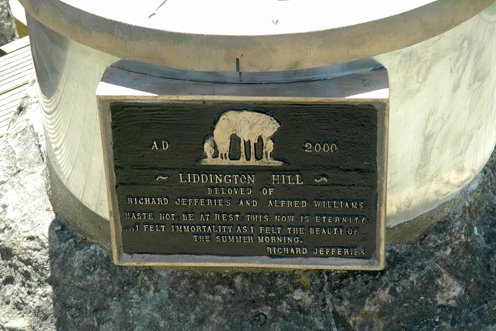
Liddington Plaque and Viewing Table. On June 24th around 50 people attended an event at Liddington Hill when a memorial plaque and direction marker was unveiled by Lord Joffe. The weather was perfect, the views superb and a skylark sang overhead to add to the atmosphere of the occasion. Lady Treitel expressed thanks on behalf of the Richard Jefferies Society and read an appropriate passage from 'The Story of my Heart'. The erection of the viewing table and plaques was a millennium project planned by Liddington Parish Council who also wanted to replace the memorial plaque to Richard Jefferies and Alfred Williams that had been placed on the trig point by JB Jones [Swindon schoolmaster and scholar] some 70 years ago. This plaque disappeared a few years ago and it was assumed that vandals had pulled it down. We were pleasantly surprised to learn today that the old plaque had been found in a field and had been taken to the Bath Road Museum. As this is the first we had heard about the recovery of the plaque and, as we can see no value in placing the plaque at Bath Road Museum, we have asked for it back so that it might have place of honour at the Jefferies Museum. Photo: courtesy Gordon Wilson, Liddington Parish Council.